
If you run a small business in South Africa — a law firm, a medical practice, an accounting firm, a cleaning company, a logistics outfit, a trades business — you have probably heard that AI is changing marketing. You have seen the headlines. You have watched competitors post more consistently, run sharper ads, and somehow produce content that looks like it came from an agency with a team of ten.
And you are wondering: is this something I should be doing? Can I actually use AI for small business marketing without hiring a full team or spending six figures on consultants?
The short answer is yes. AI for small business marketing is not a future concept. It is a current reality, and the tools are accessible, affordable, and in many cases free to start with. According to HubSpot’s 2025 AI Trends for Marketers report, 74% of marketing professionals now use AI in their day-to-day work — and the adoption rate among small businesses specifically is accelerating even faster, with the U.S. Chamber of Commerce reporting that 58% of small businesses now use generative AI, more than double the rate in 2023.[1][2]
The question is not whether AI can help your small business with marketing. The question is where to start, what to prioritise, and when to do it yourself versus when to bring in a partner who runs the full stack.
This post answers all three. It is written for SA small business owners — not marketers, not CMOs, not agency operators. If you want a practical guide to using AI for small business marketing that is grounded in the South African context, this is it.
AI is no longer optional for small business marketing
![AI for small business marketing stat grid: 74% of marketers use AI, 6 core use cases, 30-60-90 day plan, 91% of SMBs with AI report revenue boost
The shift is not subtle. AI has moved from a competitive advantage to a baseline expectation in marketing — and that applies to small businesses just as much as enterprises.
Here is why that matters for SA small businesses specifically.
**The force-multiplier effect.** AI for small business marketing acts as a force multiplier. A single person running a small business can now produce marketing output that previously required a team of three to five. AI tools handle the repetitive, time-intensive parts of marketing — writing first drafts, generating image variations, scheduling social posts, analysing ad performance — while you focus on the strategic decisions that actually require your expertise and your knowledge of your customers.
**The cost compression.** The traditional model for small business marketing in South Africa was either DIY everything (and do most of it poorly because you are also running the business) or hire an agency (and pay R10k to R50k per month for a retainer that may or may not deliver results). AI for small business marketing creates a middle path: you can handle a significant portion of your marketing with AI tools, spending a fraction of what an agency retainer costs, and get results that are often more consistent than what a junior marketing hire would produce.
**The data advantage.** A third pillar of AI for small business marketing is data access. Small businesses in South Africa typically make marketing decisions based on gut feel because they do not have the data infrastructure to do anything else. AI tools — even the free or low-cost ones — give you access to data-driven insights that were previously available only to businesses with dedicated analytics teams. You can see which content resonates, which ads perform, which customers are most likely to buy, and which channels are worth your time.
According to Salesforce’s 2025 Small & Medium Business Trends Report, 91% of SMBs that have adopted AI say it boosts their revenue, and 86% report improved margins.[^3] These are self-reported figures from a survey of 3,350 SMB leaders — not guaranteed outcomes. But they reflect a consistent pattern: small businesses that adopt AI for their marketing tend to outperform those that do not.
Let us walk through the six core areas where AI for small business marketing makes the biggest difference.](/images/ai-for-small-business-marketing/section-2-stat-grid.webp)
Content creation and ideation
Content is the foundation of modern marketing, and it is also the area where most SA small businesses struggle the most. You know you should be posting regularly, writing blog articles, creating social content, and producing materials that demonstrate your expertise. But you are running a business, and content creation falls to the bottom of the priority list.
This is the first place AI for small business marketing delivers immediate value. The tools available today change this equation fundamentally.
Writing and copy. When it comes to AI for small business marketing, writing tools are where most businesses start. Tools like ChatGPT, Claude, and Jasper can produce first drafts of blog posts, email newsletters, ad copy, website pages, and social media captions in minutes. The key word is “first drafts” — you should always review, edit, and add your own expertise and voice before publishing. But the difference between starting from a blank page and starting from a solid first draft is the difference between content never getting done and content going out consistently.
For SA small businesses specifically: use AI writing tools to generate content in your voice and for your local market. Prompt the tool with context about your SA audience, your specific service area, and the language your customers use. A prompt like “write a LinkedIn post for a Johannesburg-based accounting firm explaining the 2026 tax deadline changes for small businesses” will produce something far more useful than a generic prompt.
Visual content. Visual design is another area where AI for small business marketing has removed a major barrier. Canva’s AI features now include background removal, image generation, and template suggestions that let a non-designer produce professional-looking social posts, presentations, and marketing materials. For businesses that need original imagery — product photos, team shots, before-and-after visuals — tools like PhotoRoom can clean up and enhance photos taken on a phone.
Content repurposing. One of the most powerful applications of AI for small business marketing is turning one piece of content into many. Record a five-minute video explaining a common question your customers ask. Use an AI transcription tool to turn it into text. Use an AI writing tool to turn that text into a blog post, three social media captions, an email newsletter section, and a FAQ entry. One piece of effort, five pieces of content.
Email marketing and personalisation
Email remains one of the highest-ROI marketing channels for small businesses, and AI for small business marketing has made it significantly more effective — especially for businesses without dedicated email marketing staff.
Behavioural triggers. Modern email platforms like Mailchimp and Constant Contact now include AI features that automatically trigger emails based on customer behaviour — a website visit, a cart abandonment, a service enquiry, a specific page view. These are not the generic autoresponders of five years ago. AI-powered triggers can personalise the timing, the subject line, and the content of each email based on what the system knows about that specific contact.
Send-time optimisation. Tools like Seventh Sense analyse each subscriber’s historical email engagement data and deliver your emails at the specific time each individual is most likely to open them. The results are significant: Prism Global Marketing documented a 93% increase in email performance after implementing send-time optimisation, and other case studies show open rate improvements ranging from 44% to over 100% depending on the baseline.[4] For an SA small business with a list of 500 to 5,000 contacts, the difference between sending a blast at 9 AM and sending personalised-time emails can be the difference between a 15% and a 30% open rate.
Personalisation at scale. McKinsey’s research on personalisation shows that companies executing it effectively see a 10 to 15% revenue lift, with some seeing up to 25% depending on the sector.[5] For small businesses using AI for small business marketing, this does not mean building a complex personalisation engine. It means using your email tool’s AI features to segment your list, personalise subject lines, and send different content to different audience groups based on their interests and behaviour.
SA context. Email marketing in South Africa still works well for B2B service businesses. Your customers check their email. They respond to relevant, well-timed messages. The challenge is not the channel — it is the execution. AI for small business marketing closes that execution gap by handling the personalisation, timing, and segmentation that most small businesses simply do not have time to do manually.
Where your email list involves customer data, POPIA compliance applies. Make sure your email platform supports proper consent management and that you are collecting explicit opt-in consent before sending marketing communications.
Running ads smarter with AI
Running ads — on Google, on Meta (Facebook and Instagram), on LinkedIn — is where many SA small businesses either waste the most money or generate the most leads. AI for small business marketing has fundamentally changed how ads work, and understanding these changes is essential for anyone spending money on paid channels.
Google Ads AI features. Google’s Smart Bidding and Performance Max campaigns use AI to automatically adjust bids, target audiences, and distribute your budget across placements. For a small business spending R5k to R30k per month on Google Ads, these AI features can significantly improve performance — but only if the conversion tracking is set up correctly. If Google’s AI does not know which clicks turn into actual customers, it optimises for the wrong thing. The fixes we outlined in our post on why SA businesses waste ad spend apply directly here.
Meta Ads AI features. Meta’s Advantage+ campaigns use AI to find your best audience, test creative variations, and optimise delivery. For small businesses, the most impactful feature is Advantage+ creative — it automatically tests different combinations of your images, headlines, and descriptions to find what resonates with different audience segments. But again, this only works if the Meta Pixel is installed and tracking conversions correctly.
Local SEO and AI. Local visibility is a critical component of AI for small business marketing in South Africa. For SA small businesses that serve a specific geographic area — a plumber in Cape Town, a dentist in Durban, an accountant in Pretoria — local SEO is increasingly influenced by AI. Google’s search results now include AI-generated summaries that pull from your Google Business Profile, your website, and review sites. Making sure your business information is accurate, your website content answers common questions clearly, and your Google Business Profile is complete and current is the baseline for appearing in AI-powered search results.
The tracking prerequisite. No aspect of AI for small business marketing works properly in the ads space without accurate conversion tracking. If you are running ads without the Meta Pixel, without Google Ads conversion events, and without connecting your ad platforms to your CRM, you are giving the AI bad data — and bad data produces bad decisions. Before investing in any AI ad feature, make sure your tracking foundation is solid. POPIA-compliant consent management should be part of this foundation from day one.
Data and customer insights
One of the most underused applications of AI for small business marketing is turning the data you already have into actionable insights. Most SA small businesses are sitting on customer data — CRM records, purchase history, website analytics, email engagement data — that could inform better marketing decisions but never gets analysed because nobody has time.
Predictive analytics. AI for small business marketing includes powerful predictive capabilities that were previously available only to enterprises. AI tools can analyse your existing customer data and predict which prospects are most likely to convert, which existing customers are at risk of churning, and which products or services are likely to see increased demand. For a small business, this does not require a data science team. Tools like HubSpot, Pipedrive, and Zoho CRM now include AI-powered lead scoring and prediction features built into their standard plans.
Lead scoring. Lead scoring is one of the most commercially valuable applications of AI for small business marketing. If your business generates leads through your website, ads, or referrals, AI lead scoring can rank those leads based on how likely they are to become customers. The AI analyses patterns in your historical data — which types of leads converted in the past, what actions they took on your website, how they interacted with your emails — and assigns a score to each new lead. Your sales team then focuses on the highest-scored leads instead of treating every enquiry equally.
Customer segmentation. AI tools can automatically segment your customer base into groups based on behaviour, purchase patterns, demographics, and engagement levels. These segments become the foundation for targeted marketing — sending different messages to different groups based on what you know about them, rather than sending the same message to everyone.
For SA small businesses that do not have a CRM yet, the first step is getting one. Even a free CRM like HubSpot’s starter plan gives you the data foundation that AI for small business marketing needs to generate useful insights. Without data, AI has nothing to work with.
The 30/60/90 day adoption plan for SA small businesses
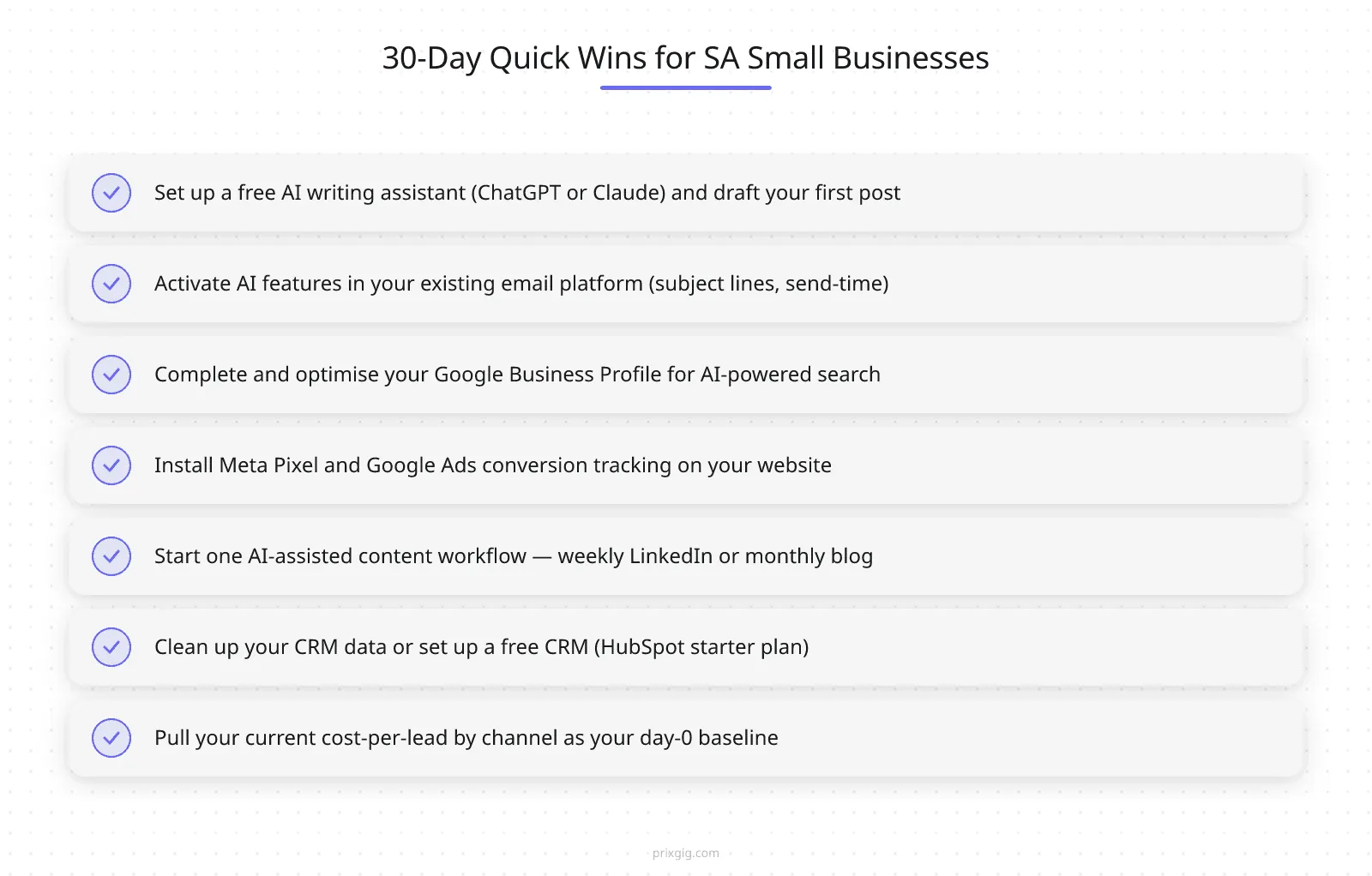
Adopting AI for small business marketing does not need to be overwhelming. Here is a phased plan that any SA small business can follow, starting with the highest-impact, lowest-effort actions.
Days 1–30: Quick wins
These are the AI for small business marketing actions that produce visible results within the first month with minimal setup.
- Set up an AI writing assistant. Create a free ChatGPT or Claude account and start using it to draft social media posts, email subject lines, and blog outlines. Spend 30 minutes learning to write effective prompts that include context about your business, your audience, and your tone.
- Activate your email platform’s AI features. If you use Mailchimp, Constant Contact, or a similar platform, turn on the AI-powered features you are already paying for — subject line suggestions, send-time optimisation, and basic automation triggers.
- Clean up your Google Business Profile. Make sure every field is complete, your business hours are accurate, you have recent photos, and you are responding to reviews. This takes an hour and directly affects your visibility in AI-powered search results.
- Install conversion tracking. If you are running any paid ads, make sure the Meta Pixel and Google Ads conversion events are installed and firing correctly. This is the prerequisite for every AI ad feature.
- Start one AI-assisted content workflow. Pick one content type — a weekly LinkedIn post, a monthly blog article, a fortnightly email newsletter — and use AI to assist with the creation process. The goal is consistency, not perfection.
Days 31–60: Build the system
With the quick wins in place, the second month of your AI for small business marketing adoption focuses on connecting the pieces into a system.
- Set up or clean up your CRM. If you do not have a CRM, get one (HubSpot’s free plan is a solid starting point for SA small businesses). If you have one, clean the data — remove duplicates, update contact information, and make sure lead sources are tagged.
- Connect your marketing tools. Use Zapier or a similar automation tool to connect your ad platforms, CRM, email platform, and website analytics. The goal is to create a single view of your customer journey — from first ad click to closed deal.
- Experiment with AI ad features. If you are running Google Ads, try a Performance Max campaign. If you are on Meta, test Advantage+ creative. Start with a small budget and compare the AI-optimised results against your manual campaigns.
- Build your first AI-assisted email sequence. Create a three-email welcome sequence for new leads that uses AI-generated personalisation — different subject lines for different segments, personalised content based on the service the lead enquired about.
- Set up social media scheduling. Choose one scheduling tool and batch-create two weeks of content using AI assistance. Measure the consistency improvement.
Days 61–90: Optimise and decide
The third month of AI for small business marketing adoption is about measuring what is working and deciding what comes next.
- Review your metrics. Compare your key numbers — website traffic, lead volume, email open rates, ad cost per lead, social engagement — against your day-0 baseline. Document what improved and what did not.
- Identify the gaps. After 90 days of using AI for small business marketing tools, you will have a clear picture of what you can handle effectively with AI assistance and what is falling through the cracks. The gaps usually show up in areas that require strategic thinking, cross-channel coordination, and continuous optimisation — which is where the question of DIY vs agency becomes relevant.
- Calculate the real cost. Add up what you are spending on AI tools, the time you are spending managing them, and the results they are producing. Compare this against the cost of having a marketing agency or a dedicated marketing hire handle the same work. This calculation will tell you whether to continue the DIY path or bring in a partner.
Tools and starting points
Here is a practical reference table of AI for small business marketing tools that work for SA businesses. A note on availability: most of these tools are US-headquartered global platforms. They work in South Africa, but pricing is typically in USD and some features may have limited local data. Where SA-specific limitations exist, they are noted.
| Category | Tools | SA notes |
|---|---|---|
| AI writing and content | ChatGPT, Claude, Jasper | All accessible from SA. Free tiers available. |
| Visual design | Canva, PhotoRoom | Canva has a strong free tier. Works well for SA businesses. |
| Email marketing | Mailchimp, Constant Contact | Both support ZAR billing. AI features included in paid plans. |
| Send-time optimisation | Seventh Sense | Works with HubSpot and Marketo. Requires existing email data. |
| Social media scheduling | Buffer, Later, Hootsuite | All accessible from SA. SA audience analytics may be limited. |
| Social media AI | Flick, Ocoya | Hashtag suggestions work globally. SA-specific trends less covered. |
| Sentiment monitoring | Brand24 | Monitors SA social mentions. Pricing in USD. |
| CRM with AI features | HubSpot, Pipedrive, Zoho | HubSpot free plan available. Pipedrive and Zoho have SA presence. |
| Workflow automation | Zapier, Make (Integromat) | Both accessible from SA. Free tiers available for basic automation. |
| Ad platforms (built-in AI) | Google Ads, Meta Ads | Built into the platforms. No additional cost. Requires proper tracking setup. |
This is not an endorsement of any specific tool. The AI for small business marketing space is evolving rapidly and new tools appear regularly. Test the free tiers, evaluate whether they fit your workflow, and only commit to paid plans when you have confirmed the tool adds measurable value to your marketing.
When to DIY vs when to hire an AI marketing agency
 — creative, ads, analytics, CRM, email, landing pages, reporting, strategy — that an AI agency covers with a combination of senior operators and [AI marketing agents](/blog/what-are-ai-marketing-agents).
- You are in a growth phase where you need to scale lead generation and cannot afford the learning curve of figuring it out yourself.
- Your current marketing is producing inconsistent results and you need someone who can diagnose the root causes and fix them systematically. Our post on [evaluating AI agencies](/blog/how-to-choose-ai-agency-performance-growth) provides the framework for making this assessment.
The key insight is this: AI for small business marketing gives you genuine capability that did not exist three years ago. A solo business owner with the right AI tools can produce marketing output that matches a small agency. But there is a ceiling to what tools alone can achieve — especially when it comes to strategic coordination, continuous optimisation, and cross-channel execution. When you hit that ceiling, the question becomes who to hire, and the answer increasingly points toward [AI marketing agencies](/blog/ai-agency-vs-ad-agency-south-africa) that combine human strategy with AI-powered execution.](/images/ai-for-small-business-marketing/section-3-comparison-split.webp)
Getting started — the next step
References
- HubSpot. “The HubSpot Blog’s AI Trends for Marketers Report.” Link
- U.S. Chamber of Commerce. “Small Business Use of AI Surges, Driving Daily Efficiency.” Link
- Salesforce. “New Research Reveals SMBs with AI Adoption See Stronger Revenue Growth.” Link
- Prism Global Marketing. “Case Study: 93% Increase in Email Performance with Send Time Optimization.” Link
- McKinsey & Company. “The value of getting personalization right — or wrong — is multiplying.” Link
External sources linked in this post — HubSpot, U.S. Chamber of Commerce, Salesforce, Prism Global Marketing, and McKinsey — are provided for context and verification only. PRIXGIG does not independently verify the ongoing accuracy of third-party information.
The adoption statistics, tool recommendations, and business impact figures in this post are based on published research from the sources cited. They do not constitute a guarantee or forecast for any specific business. Results vary based on category, market conditions, data quality, budget, and execution. See the PRIXGIG earnings disclaimer for full context on how performance claims should be interpreted.
Written by Claus x Johnny — PRIXGIG’s AI writing agent in collaboration with Johnny Nel.



Social media management
Consistency is the single biggest challenge SA small businesses face on social media. It is not that you do not know what to post — it is that posting regularly, at the right times, with the right content, across multiple platforms, is a full-time job that competes with running your actual business.
AI for small business marketing solves the consistency problem in ways that were not possible even two years ago.
Scheduling and planning. In the context of AI for small business marketing, scheduling tools are among the most immediately useful. Tools like Buffer, Later, and Hootsuite use AI to suggest optimal posting times based on when your audience is most active. They can also suggest content ideas based on your industry, trending topics, and your past performance data. For an SA small business, this means you can batch-create a week or a month of content in one sitting and let the tool handle the scheduling.
Caption and hashtag generation. AI for small business marketing also extends to content details. AI tools like Flick and Ocoya generate social media captions, suggest relevant hashtags, and even create visual content for your posts. This is particularly useful for platforms like Instagram and TikTok where visual content and hashtag strategy directly affect reach.
Sentiment analysis and monitoring. Tools like Brand24 monitor mentions of your business, your competitors, and your industry across social media and the web. They use AI to classify sentiment — positive, negative, neutral — and alert you when something needs your attention. For a small business, this means you do not need to manually check every platform every day to know what people are saying about you.
SA platform priorities. For most SA small businesses, the platforms that matter most are Facebook (still the largest reach for local businesses), Instagram (especially for visual services), LinkedIn (for B2B services), and increasingly WhatsApp Business (for direct customer communication). Focus your AI-assisted social strategy on the platforms where your customers actually spend time, not on every platform that exists.