
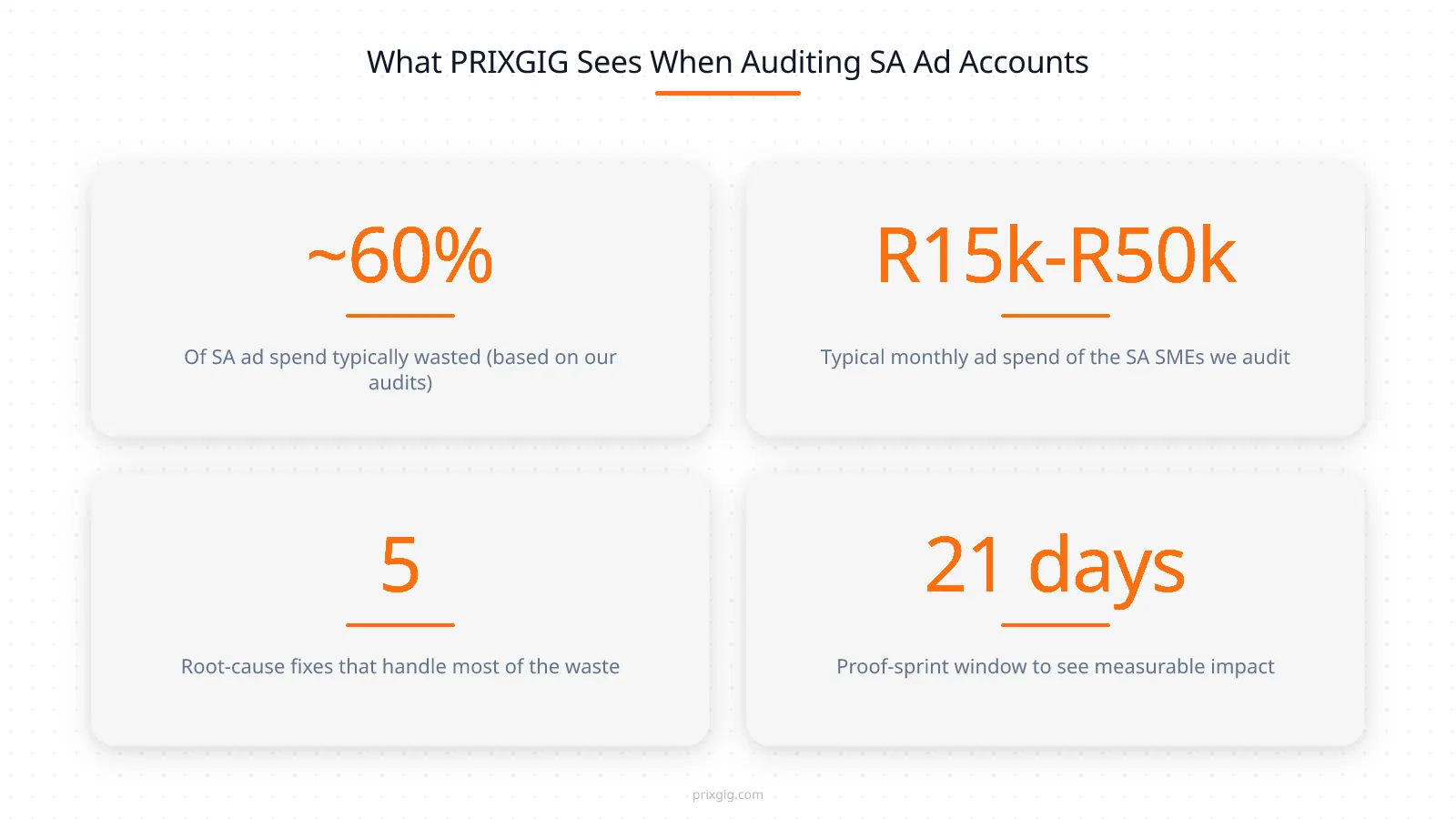
Most SA service businesses PRIXGIG audits are spending between R15,000 and R50,000 a month on paid ads — Meta, Google, sometimes TikTok — and most of them are wasting the majority of that budget.
Not because the paid ads platforms don’t work. Not because their product or service is wrong. Because the paid ads setup is broken from day one, and nobody has told them what to fix or in what order.
This post is the five fixes that matter for paid ads performance. Every one of them is derived from PRIXGIG’s audit work with SA service businesses running paid ads over the last few years — the patterns are consistent enough to be predictive. If you’re running paid ads and can’t tell what’s actually producing pipeline, start here.
The ad spend reality in South Africa
Five root causes of wasted paid ads budget
Fix 1 — Tracking infrastructure (Meta Pixel, GA4, server-side)
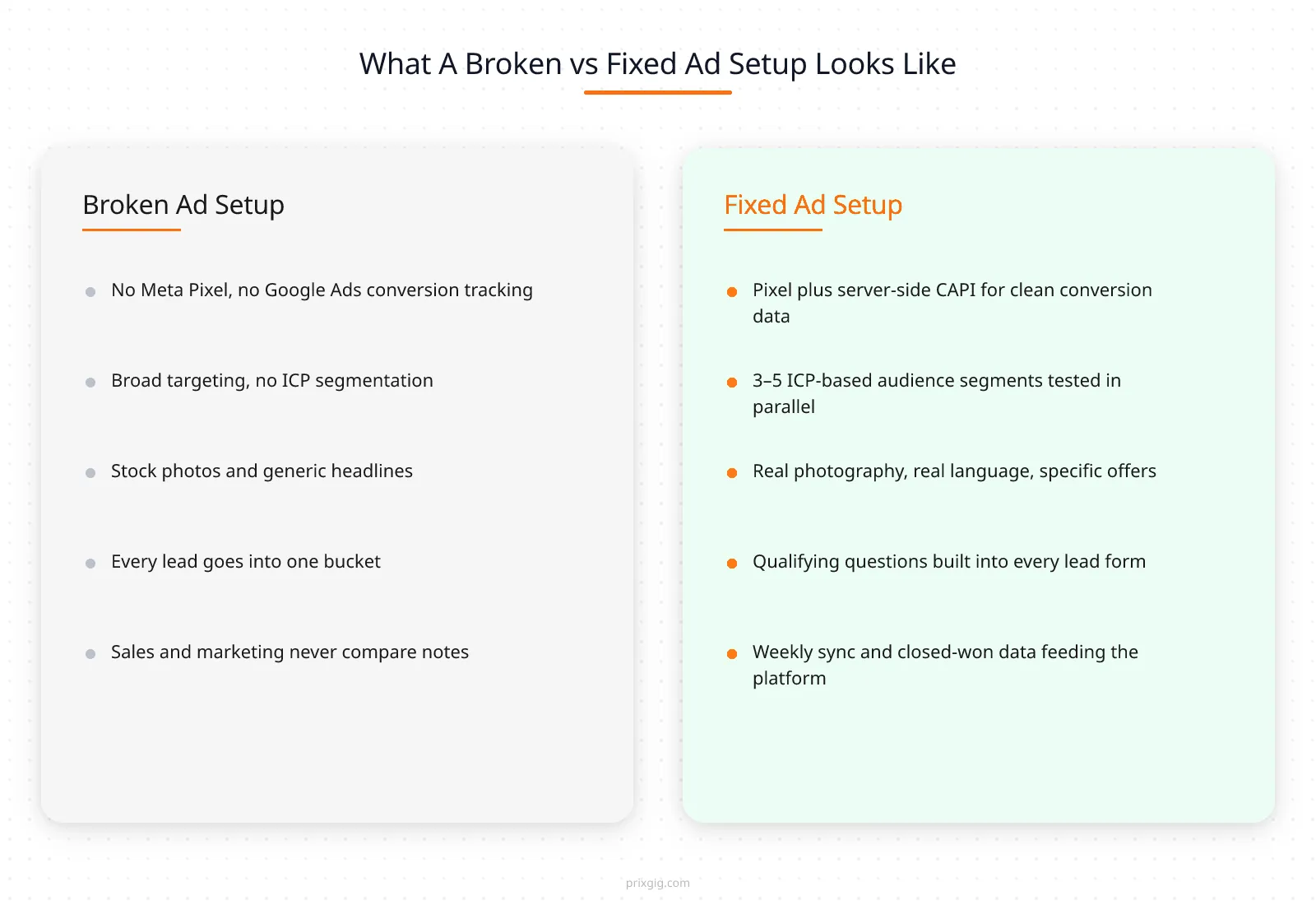
You cannot optimise what you cannot measure. We regularly walk into SA businesses spending R30,000 a month on Meta paid ads with no pixel installed, no conversion events configured, and no way to tell which ad produced which lead. When the platform can’t see what’s converting, it cannot learn who your real customers are, it cannot optimise towards them, and it cannot tell you what’s actually working — so your paid ads budget burns in the dark.
This is the single most common reason paid ads underperform in SA, and it’s the first thing we fix on every paid ads account we touch.
What to fix, in order:
- Install the Meta Pixel on every page of your site via Google Tag Manager, not hardcoded in the page template. Verify it fires using the Meta Pixel Helper browser extension.
- Configure conversion events for every meaningful action: lead form submissions, WhatsApp click-throughs, phone-number clicks, calendar bookings, checkout initiations. Each event needs a clear definition and a reliable trigger.
- Set up the Conversions API (CAPI) server-side. Browser-side tracking is increasingly blocked by privacy settings and ad blockers; server-side events fire regardless and give Meta much cleaner data to learn from.
- Set up Google Analytics 4 with enhanced conversions — this is Google’s documented approach to recovering conversion signal that cookie restrictions would otherwise drop.[1]
- Wire your CRM to the ad platform via webhook or native integration so that when a lead becomes a closed-won deal, the platform gets that signal and can optimise future campaigns toward people who look like the ones that actually converted.
POPIA consideration: tracking pixels and server-side events collect personal information, which means they fall under the Protection of Personal Information Act (POPIA) in South Africa.[2] Every tracking implementation must include POPIA-compliant consent flows at the point of data capture, not bolted on afterwards. This is non-negotiable for SA businesses, and it’s one of the first things a partner you’re evaluating should bring up unprompted.
Get this stage right and the rest of the fixes get easier, because you suddenly have reliable data to work with.
Fix 2 — Audience targeting that actually works
The second most common reason SA businesses waste paid ads budget: broad targeting with no strategy. “Let’s target everyone in Johannesburg aged 25 to 55” is not a paid ads strategy. It’s a donation to Meta’s budget optimiser, and the outcome is almost always wasted paid ads spend.
Effective paid ads in SA start with a clearly defined Ideal Customer Profile (ICP). Who are the people who actually buy from you? What do they care about? What language do they use? What do their job titles look like? Which LinkedIn groups do they belong to? What problem are they trying to solve at the moment they see your ad?
What to fix:
- Build 3–5 detailed audience segments based on your actual closed-won customer data — not assumptions, not gut feel, not a persona document from 2022. Pull the last 50 customers and look for the patterns.
- Test each segment independently with dedicated creative tailored to what that segment actually cares about. You should see different performance on different segments. If they all perform the same, your segmentation is fake.
- Kill broad-interest audiences on Meta. Use custom audiences built from your first-party data, look-alike audiences off your closed-won list, and tightly defined interest stacks that reflect your ICP.
- For Google Ads, build tight keyword groups around buyer-intent queries, not top-of-funnel research queries. Someone searching “how does [category] work” is not the same lead as someone searching “best [category] in Johannesburg” — yet most accounts treat them identically.
The WordStream Google Ads benchmarks[3] show that across industries, the gap between average and top-quartile cost-per-lead is often 3–5x. Segmentation and targeting discipline is a big part of what separates those groups.
Fix 3 — Creative that earns the scroll-stop
If your paid ads look like stock photos with a logo slapped on top, your target audience is scrolling past before their brain has even registered you exist. South African consumers — and business decision-makers in particular — have developed an extremely fast filter for generic paid ads creative. They stop for content that feels specific, real, and relevant to their actual situation.
What to fix:
- Shoot real content. Your team, your office, your actual client results (with permission), the thing you actually do. Phone-camera footage that’s honest will outperform a polished stock video for almost every SA service business we’ve audited.
- Use the language your customers actually use. Not corporate buzzwords and category jargon — the exact words a prospect said on your last discovery call about why they reached out. Record your calls, listen back, and lift the phrases verbatim.
- Write specific offers. “Get a free consultation” converts at a fraction of the rate of “Get the 21-day audit we run for SA service businesses spending R15K+ on ads.” Specificity earns attention.
- Stop trying to look like a multinational. Start looking like someone your prospect would actually have coffee with. Polish is less important than authenticity in SA paid ads right now.
- Test 3–5 creative variants per audience segment minimum. Meta and Google both reward paid ads accounts that feed them multiple creatives to compare — single-creative campaigns waste the algorithm’s learning budget.
Fix 4 — Lead qualification built into the ads
Generating leads is step one. But if every lead goes into the same bucket — no scoring, no qualification, no routing logic — your sales team wastes hours chasing people who were never going to buy, and your cost-per-sale balloons even when cost-per-lead looks reasonable.
The right structure is to build qualification directly into the lead capture itself, before a lead ever reaches your sales team.
What to fix:
- Add two or three qualifying questions to every lead form: current budget range, timeline, company size, or the specific problem they’re trying to solve. Even one well-chosen question cuts out a large share of tyre-kickers.
- Score incoming leads automatically based on those answers, and route high-quality leads directly to your best closer while low-quality leads go into a nurture sequence.
- Set up automated responses for low-quality leads — a useful resource or an educational sequence — so they still get value and don’t leave with a bad impression of the brand.
- Use WhatsApp as the first-touch channel where appropriate — SA’s WhatsApp usage rate is exceptional, and an AI-assisted qualification flow on WhatsApp can convert a raw lead into a qualified pipeline entry in under a minute.
The goal is that your sales team spends their time on calls that have a real chance of closing, not filtering out prospects the ad platform never should have sent in the first place.
Fix 5 — Closing the sales feedback loop
This is the paid ads fix that costs the most money long-term and gets the least attention. If your sales team is not telling the paid ads platform which leads actually converted to revenue — and which didn’t — the algorithm can’t improve. You’re stuck in a cycle of generating the same mediocre leads month after month, because the platform has no way of knowing who your real customers are.
What to fix:
- Schedule a weekly 15-minute sync between sales and marketing. Not a deck. Raw numbers. Which leads came in this week, which ones converted, which ones were junk, why. Write it down.
- Push closed-won data back to the ad platforms via the CRM integration you set up in Fix 1. Meta and Google both reward accounts that send them accurate conversion-value data — the algorithms will bid more aggressively for prospects who look like your real buyers, and less for prospects who look like the people who filled out the form and ghosted.
- Build offline conversion tracking for leads that become revenue days or weeks later. A lead that converts 30 days after the ad click is the most valuable signal you can give the platform, but most accounts never capture it because their CRM and their ad platform don’t talk to each other.
Get this loop running for 60 days and you will see the underlying paid ads campaign performance shift. The platform literally gets smarter about who to show your paid ads to, because it finally has the data to learn from.
What to do this week
. And if you want to understand how AI tools can handle much of this without an agency, our [practical guide to AI for small business marketing](/blog/ai-for-small-business-marketing) walks through the DIY path step by step.
|||final_cta|||
Apply for the 21-Day Sprint|If you want someone to run this process on your account for you, PRIXGIG runs a 21-day proof sprint for SA service businesses spending R15,000+ per month on paid ads — zero management fee during the sprint, and a deliberately small intake each quarter. The sprint either produces qualified leads inside 21 days, or we keep running until it does.
|||end_final_cta|||](/images/why-sa-businesses-waste-ad-spend/section-8-checklist.webp)
Frequently Asked Questions
How do I know if my current tracking is actually working?
The fastest check for Meta is the Meta Pixel Helper browser extension — it shows you in real time which events fire on which pages. For Google Ads, use the “Conversion Status” report inside Google Ads and confirm the status shows “Recording conversions.” For GA4, go to Admin → DebugView and walk through a test conversion on your own site while watching events appear. If any of these show nothing, your tracking isn’t working and you are flying blind.
What’s a reasonable cost-per-qualified-lead for SA service businesses on paid ads?
It depends heavily on category, offer, and lifetime value. Professional services (legal, financial, medical, B2B consulting) often sit in the R300–R1,500 per qualified lead range. Lower-ticket consumer services are usually cheaper; high-ticket B2B is usually more expensive. The wrong question is “what’s normal?” — the right question is “what can my business afford given my average sale value and close rate?” Work backwards from the unit economics, not from industry averages.
Do I need an ad agency to run paid ads properly, or can I do this in-house?
Either can work. What doesn’t work is hiring a social media manager (who posts content) and expecting paid ads results, or hiring a generalist marketer and expecting them to handle the full tracking + creative + optimisation stack. If you go in-house, hire someone who has specifically run paid ads for SA service businesses before. If you go agency, make sure they’ll show you raw data and do not hold your ad accounts hostage.
How long should I run a campaign before deciding it’s broken?
Minimum 2–3 weeks at meaningful spend to let the algorithm learn. If you’re running below 30–50 conversions in the first 30 days, you either don’t have enough spend or your tracking isn’t firing. A genuinely broken campaign usually shows itself inside the first 3 weeks — if your cost-per-qualified-lead is still 3x your target on week 4 with clean data, something structural is wrong.
Why does everyone keep talking about POPIA for paid ads?
Because every pixel, cookie, and audience-building action on a South African website involves processing personal information, which is regulated under POPIA. Non-compliance is a real legal risk, not a theoretical one. A good paid ads partner raises POPIA in the first three conversations unprompted — if they don’t, keep looking.
What happens if the “five fixes” don’t work for my business?
The fixes work when the underlying offer, market, and audience are genuinely viable. If after 21 days of a properly-run paid ads system your numbers still don’t work, the problem is usually upstream: the offer isn’t differentiated, the price-to-value ratio is off, or the audience you’re chasing isn’t actually looking to buy right now. Paid ads amplify whatever is already there — they cannot manufacture demand that doesn’t exist. An honest audit tells you which it is.
References
- Google Ads Help. “Automated bidding overview.” Link
- Government of South Africa. “Protection of Personal Information Act, 2013 (POPIA).” Link
- WordStream by LocaliQ. “Google Ads Benchmarks for your Industry.” Link
External sources linked in this post — Google Ads documentation, the POPI Act, and WordStream industry benchmarks — are provided for context and verification only. PRIXGIG does not independently verify the ongoing accuracy of third-party information.
Audit patterns and outcome ranges discussed in this post are drawn from PRIXGIG’s own work with SA service businesses and do not constitute a guarantee or forecast for any specific account. Results vary based on category, offer, data quality, budget, and execution. See the PRIXGIG earnings disclaimer for the full context on how past-results claims should be interpreted.
Written by Claus x Johnny — PRIXGIG’s AI writing agent in collaboration with Johnny Nel.