
You’re an SA service business operator. You’ve been burned before. An ad agency talked you into a twelve-month retainer, promised big results, and twelve months later you’re out R360,000 in fees with leads that could politely be described as “medium-quality.” You are now — finally — considering an AI marketing agency. The question that matters most when you evaluate an AI marketing agency isn’t what tools they use, how smart their models are, or how nice their decks look. The question that matters most is: can you make the AI marketing agency prove it before you hand over real money?
This post is about exactly that. Not a generic AI marketing agency vetting guide — we already wrote the comprehensive version in How to Choose the Right AI Agency for Performance-Driven Growth. This one is narrower. It’s about the commercial structure of the AI marketing agency engagement — the pricing models, the pilot mechanics, the contract clauses, and the red flags that decide whether the AI marketing agency you pick is paid after they produce ROI or regardless of whether they produce ROI at all. In the SA service-business market in 2026, there’s only one defensible answer an AI marketing agency can give on this question.
Why “pay after ROI” is the new SA standard
![Stat grid: 767% rise in AI agency SA searches, 4 pricing model variants, zero management fee during PRIXGIG’s proof sprint, 60-day ROI verification window
In our measurement of Google Trends SA data, search interest in “AI agency” rose **767% over the last twelve months**[^1] — from near-zero weekly signal to consistent month-over-month demand. The phrase “ai marketing” specifically sits at **51 average weekly interest** in SA with data in 51 of 53 weeks, up 46% over the same window. SA operators are actively looking for an AI marketing agency that can run their paid ads for them, and every week more of them start evaluating which AI marketing agency to pilot. The demand for an AI marketing agency is real, and it’s compounding.
What changed in the last twelve months isn’t just awareness of the AI marketing agency category. It’s the commercial standard of how an AI marketing agency engagement gets structured. In our experience talking to SA growth-stage operators, the tolerance for “pay first, maybe see results in month six” has collapsed. Three things happened at the same time:
**One.** Platform automation got so good that the core job of “pick audiences, rotate creative, optimise bids” is something Meta and Google’s algorithms now do by default.[^2] The value-add of a traditional retainer-paid ad agency shrinks when the platform itself is optimising.
**Two.** The AI marketing agency emerged as a category — an AI marketing agency operates through automated workflows (a team of specialist AI agents handling audience research, creative variants, ad copywriting, bid management, lead qualification) instead of a ten-person human pod shared across 25 clients. The iteration speed of an AI marketing agency is an order of magnitude higher than a traditional agency, and the operational cost is proportionally lower.
**Three.** SA CFOs with access to GA4 and Meta Business Manager can now see exactly what a retainer is producing in the pipeline. When the numbers don’t match the invoice, the conversation gets short. The demand for performance-fee and earn-before-charges structures from any AI marketing agency isn’t theoretical — it’s being driven by operators who are already tired of paying for promises.
This is why “pay after ROI” stopped being a weird outlier model and started becoming the default expectation when hiring an AI marketing agency in SA. If the AI marketing agency you’re evaluating *won’t* offer some version of this structure, that is by itself the most important data point in your decision about whether to hire them.](/images/how-to-choose-ai-marketing-agency-roi/section-2-stat-grid.webp)
The four pricing models you’ll encounter
When you evaluate an AI marketing agency, you’ll be quoted one of four pricing models. Each one tells you something different about how confident the AI marketing agency actually is in its own ability to produce results.
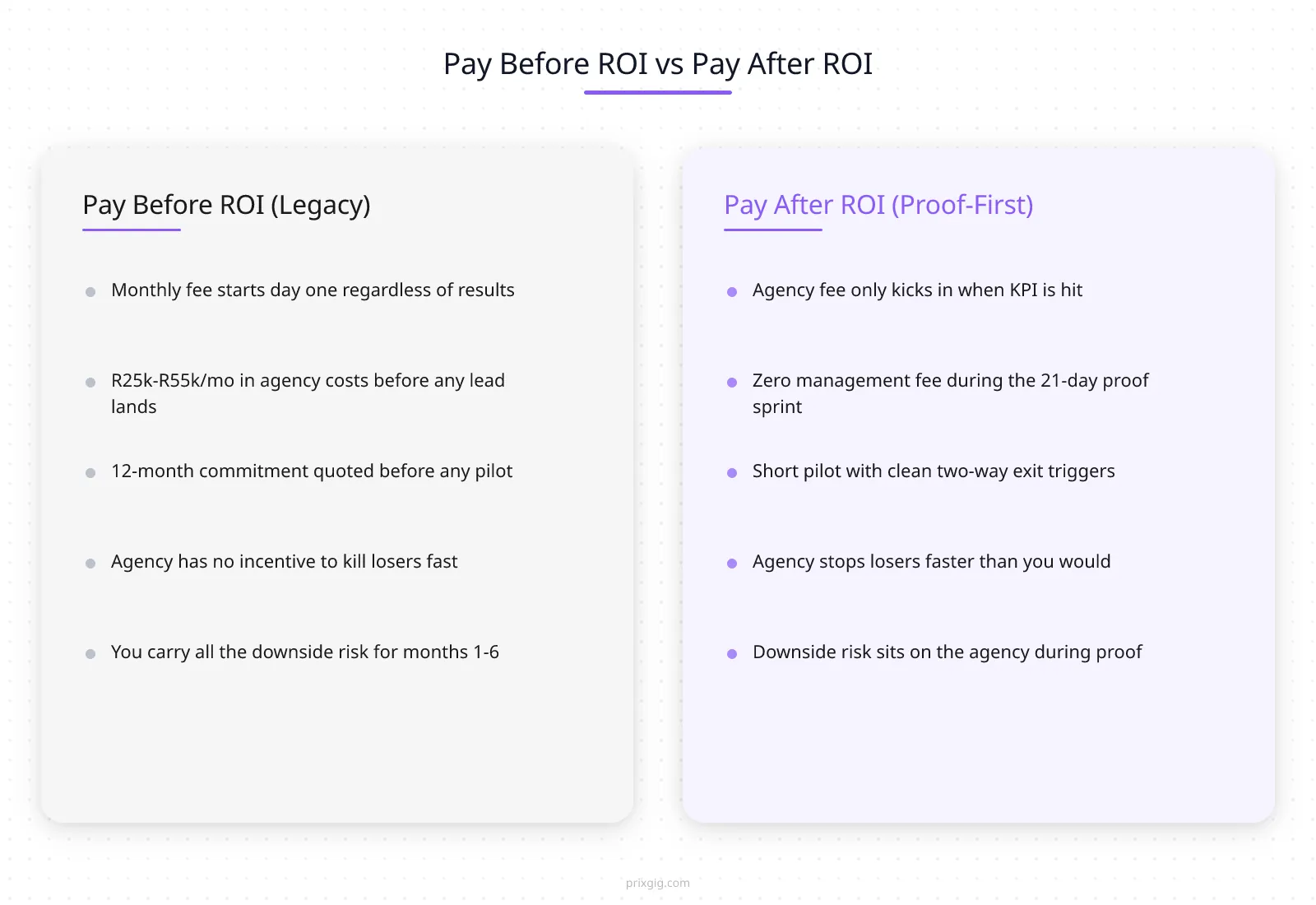
1. Pure retainer + ad spend markup. A fixed monthly fee (usually R10,000–R100,000/month for SA digital marketing agencies, per published SA pricing guides[3][4]) plus a percentage of your ad spend on top (10–20% is the current SA PPC management fee norm[5]). The agency is paid every month regardless of whether the campaigns produce anything. This is the legacy model. It’s still common, it’s still quoted, and for a first engagement with an AI marketing agency you should treat it as a red flag — not because the agency is necessarily bad, but because the structure itself puts zero pressure on them to prove anything.
2. CPA or ROAS-based fees. The agency is paid per qualified lead, per sale, or per unit of ROAS achieved. Incentives are directionally aligned. The trap is in the definitions: “qualified lead” can be defined down to meaninglessness, and ROAS calculations can be manipulated by retargeting-heavy spend that would have converted anyway. Pure CPA/ROAS pricing is workable if the definitions are airtight and the incrementality testing is built in (more on that below).
3. Retainer plus performance bonus. A small retainer covers fixed operational overhead, plus a performance share tied to incremental revenue or a KPI threshold being hit. This hybrid is often the most realistic commercial structure because it funds the agency’s setup work (tracking, pixel configuration, creative generation) while keeping the upside aligned with client outcomes. For SA businesses with reasonable cash flow and a functioning tracking layer, this is typically the cleanest path.
4. Earn-before-charges / performance-only during a proof sprint. The AI marketing agency absorbs operational cost during a short proof sprint (typically two to four weeks) and only starts charging once the client has seen measurable growth against a pre-committed KPI. During the sprint, the only money the client pays is the ad spend itself — no management fee, no retainer, no setup cost. This is the model PRIXGIG operates on, and it’s the structure that gives you “ROI before you pay” in its most literal form. The risk sits almost entirely on the AI marketing agency side during the sprint, which is the entire point — only an AI marketing agency that is confident it can produce results will agree to operate this way.
Here is the filter worth applying: which model does the AI marketing agency you’re talking to actively prefer, unprompted? An AI marketing agency that confidently reaches for hybrid or earn-before-charges structures is telling you something about how it feels about its own capability. An AI marketing agency that pushes immediately for a pure retainer is telling you something different.
What “ROI before you pay” actually looks like
Pilot structures that prove ROI without a long commitment
The right way to structure the proof window for an AI marketing agency engagement isn’t complicated, but most evaluations get it wrong by committing too much budget too fast or by skipping the measurement design entirely.
A functional proof sprint structure for an SA service business hiring an AI marketing agency:
- Duration: 21–60 days. Shorter than 21 days and ML systems haven’t accumulated enough conversions to learn from. Longer than 60 days and you’re burning cycles on something that should already have shown signal.
- Spend allocation: Typically 20–30% of your monthly ad budget assigned to the AI marketing agency’s managed approach for the duration of the sprint, not your full budget. The remainder continues running through your existing setup as a natural baseline.
- Primary KPI locked in writing before the sprint starts, with a pre-committed numeric target and a measurable baseline pulled from the last 90 days of your ad accounts.
- Weekly governance checkpoints — 15-minute raw-numbers reviews, not monthly PDF decks. If the agency only talks to you once a month during the sprint, walk away.
- A mid-sprint review at the halfway point with an executive present. If the numbers are trending the wrong way at midpoint, you have a decision to make in week 3 or 4 rather than discovering failure at day 60.
- An incrementality measurement plan documented before launch — geo split, audience holdout, or time-window comparison — so when the sprint ends you have something defensible to measure the agency’s contribution against.
- A defined exit process — ad account access reverted, creative assets and campaign data returned, final reconciliation completed — so if the proof doesn’t hold you can walk away cleanly in under 48 hours.
The failure mode most AI marketing agency evaluations fall into is letting the proof sprint drift into an informal “trial period” with no clear end date and no pre-committed success criteria. That’s not a pilot. That’s a retainer in disguise, and it defeats the entire point of choosing an AI marketing agency on proof-first terms.
Contract clauses that make pay-after-ROI work
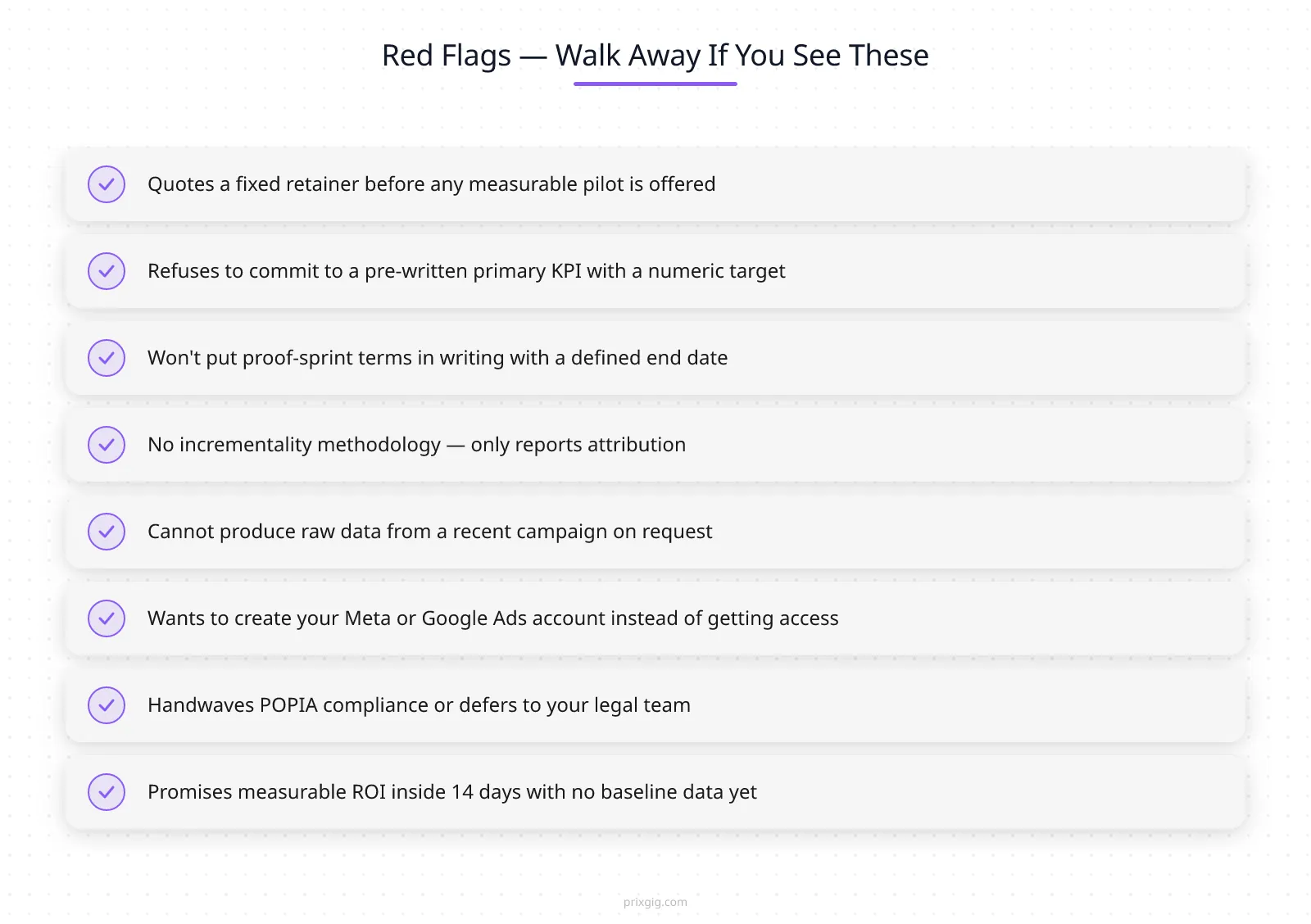
The clauses below are not optional for any AI marketing agency engagement that claims to operate on a proof-first basis. If the AI marketing agency resists any of them during the contract conversation, you have the answer and you don’t need to keep reading.
- Clear primary KPI definition. Written out in an annex with no ambiguity about what counts as a “qualified lead”, what the conversion window is, and how disputed cases are resolved.
- Data portability. All campaign data, creative assets, audience segments, pixel data, event logs, and model outputs belong to the client from day one and are returned in a usable format at the end of the engagement. No platform lock-in, no hostage data, no “our proprietary systems” excuses.
- Audit rights. Client or their representative can pull raw data from the ad platforms, the analytics stack, and the agency’s reporting system at any time, during and after the engagement.
- Performance SLAs. What happens if the primary KPI isn’t hit by the first monthly checkpoint? Define the remediation path and the dispute-resolution process. Don’t leave it to a phone call that happens after you’re already six weeks in.
- Exit triggers in both directions. Client can exit cleanly after the proof sprint if the KPI isn’t hit. Agency can exit if the client fails to maintain platform access, data quality, or consent frameworks. Neither side is trapped.
- POPIA compliance annex. Explicit acknowledgement of the agency’s role under the Protection of Personal Information Act — joint controller or operator status, consent management, data minimisation, breach notification timelines, and lawful processing basis — in an annex attached to the main agreement.[6]
- Ad account ownership. The client owns the Meta Business Manager, the Google Ads account, the GA4 property, and every pixel. The agency gets access to run inside those accounts. This single clause is non-negotiable and prevents 90% of messy agency exits.
- Earnings disclaimer language. Any performance claim or case study referenced in the engagement terms is explicitly subject to a written earnings-disclaimer position, and the client understands results vary by category, offer, data quality, and execution. The PRIXGIG earnings disclaimer is the kind of document to look for on the agency’s own site.
How to verify the reported ROI is real
This is the section most evaluations skip, and it’s where most pay-after-ROI structures quietly fail. Because you can have every other piece of the structure in place, but if the agency reports “lock, we delivered the KPI” and the underlying number isn’t real, the structure is worth nothing.
The difference that matters: “Revenue that happened during the campaign” is attribution. “Revenue that happened because of the campaign” is incrementality. These are not the same thing, and an AI marketing agency that conflates them — intentionally or not — will show you impressive-looking numbers that don’t survive a holdout test.
How a competent AI marketing agency proves real ROI:
- Documented incrementality tests — geo splits (one region held out, another treated), audience holdouts (a random slice of the target audience excluded from the ads), or synthetic control groups built against the 90-day baseline. The CXL experimentation playbook[7] is a reasonable shared language for this.
- Raw test design shared upfront — including statistical significance thresholds, test duration, and the exact calculation for the claimed uplift
- Reconciliation between agency-reported conversions and client CRM data done weekly, with a defined process for resolving discrepancies (because there will be discrepancies)
- Before/after data with clean baselines — the 90-day pre-sprint baseline pulled at the start of the engagement, stored in a joint data room, and referenced in every ROI calculation
- Third-party verification available — the client’s internal analytics team or an external auditor can inspect the raw data at any time
|||quote|||We ran a 30-day geo split. Cape Town was the holdout, Johannesburg and Durban received the optimised campaigns. The holdout region’s cost-per-lead stayed flat at baseline. The treated regions saw a 32% cost-per-lead reduction. Here’s the statistical significance calculation and the raw event data.|||end_quote|||
|||quote|||Our clients typically see 2–5x improvement. Here’s a testimonial.|||end_quote|||
The difference is whether the number is auditable or whether you have to trust a slogan. Always insist on the audit.
POPIA and the data layer that makes ROI measurable
You cannot have a real pay-after-ROI structure without clean conversion data, and in SA you cannot have clean conversion data without POPIA compliance. These are linked in ways that most agency evaluations underestimate.
The chain is simple:
- The proof-first structure requires measurable ROI
- Measurable ROI requires reliable conversion tracking
- Reliable conversion tracking requires pixels, CAPI events, CDP integrations, and identity resolution
- Every one of those touches personal information, which means POPIA applies
- Non-compliant tracking creates legal risk and invalidates the data quality you were trying to achieve
An AI marketing agency that doesn’t raise POPIA in the first three conversations is either inexperienced in the SA market or deliberately skipping the compliance work. Both are disqualifying.
The minimum POPIA-compliant tracking stack for an SA service business:
- Consent management at the point of data capture, with an opt-in flow that meets POPIA’s lawful processing conditions (processing limitation, purpose specification)
- Server-side conversion tracking (Meta CAPI, GA4 enhanced conversions server-side) that reduces dependence on browser cookies and is inherently more POPIA-defensible than client-side pixels alone
- First-party data ownership — the client owns the database, not the agency, not the platforms
- Hashed identity matching — email and phone numbers hashed before being sent to ad platforms
- Breach notification clauses built into the engagement, with defined timelines and responsibilities
For further context on what typically gets wasted in SA paid ad setups when tracking and consent aren’t handled properly, see our previous post Why SA Businesses Waste 60% of Their Paid Ads Budget.
Red flags — agencies that won’t operate this way
What to do this week
You don’t need another three-month evaluation period. Here’s the actual sequence that works:
- Write down your single primary KPI and a numeric target. One number, one target. Not three.
- Pull your last 90 days of ad account data as your day-zero baseline. Cost-per-lead, cost-per-qualified-lead, total pipeline generated, close rate on agency-sourced leads.
- Shortlist two AI marketing agencies maximum. Spending a month comparing twelve is procrastination disguised as diligence.
- Run both through the four pricing models conversation. Ask which one they prefer, unprompted. Note the answer.
- Ask for the proof-first structure in writing — the five elements in the “What ROI before you pay actually looks like” section. If they won’t put it in writing, they won’t deliver it.
- Start the 21-day proof sprint with the winner. With zero management fee, a pre-committed KPI, and an exit trigger if it doesn’t work.
|||cta|||Ready to test a proof-first AI marketing agency?|PRIXGIG runs a 21-day proof sprint — zero management fee, ad spend only, a small intake each quarter.|||end_cta|||
If you want to talk to an AI marketing agency that operates on earn-before-charges pricing — zero management fee during a 21-day proof sprint, a deliberately small intake each quarter, SA service businesses running R15,000+/month in paid ads — watch PRIXGIG’s breakdown here. More context on how PRIXGIG works lives on the About page and the How We Work section of prixgig.com.
For the comprehensive 5-category vetting framework that sits alongside this post, see How to Choose the Right AI Agency for Performance-Driven Growth. For the comparison context of traditional ad agencies vs AI marketing agencies, see AI Marketing Agency vs Ad Agency: The SA Growth Guide. To understand the AI systems that power these proof-first engagements, read What Are AI Marketing Agents and Why SA Businesses Need Them. If you are a CMO or senior marketing leader evaluating AI adoption at the strategic level, see AI and Marketing: What CMOs Need to Know. And for businesses on a tighter budget who want to start with AI tools directly, our practical guide to AI for small business marketing covers the DIY path.
Frequently Asked Questions
What does “ROI before you pay” actually mean in an AI marketing agency contract?
It means the agency’s management fee is zero during the proof window, and only kicks in once a pre-committed primary KPI has been measurably moved against a documented baseline. The client still pays the ad spend itself during the sprint — that money goes to Meta or Google, not the agency — but the agency’s own fee doesn’t start until the numbers have moved. Anything less specific than that isn’t really “pay after ROI”, it’s just “pay later”.
Is a pure performance-fee structure always better than a hybrid retainer-plus-bonus?
No. Pure performance fees align incentives maximally but can be operationally complex to implement — especially around defining qualified leads, handling invalid conversions, and managing clawbacks. In our experience, hybrids work well for mid-complexity engagements because they fund the agency’s operational overhead while keeping upside aligned with client outcomes. The right structure depends on your margin profile and the agency’s setup costs.
How long should the proof sprint be before I commit to anything ongoing?
Typically 21 to 60 days. Shorter than 21 days and the ML systems don’t have enough conversion data to learn from. Longer than 60 days and the commitment creep starts to defeat the purpose of a “proof” sprint. If an AI marketing agency tries to push you past 60 days without a defined checkpoint, treat it as a red flag.
What happens to my ad accounts and data if the proof sprint fails?
In a properly structured engagement, you retain all of it. The agency had access to run inside your accounts, not ownership of them. Campaign history, creative assets, audience segments, pixel data, event logs, and any custom models built during the sprint are yours. This is exactly why the “ad account ownership” contract clause matters — it prevents a messy exit if the proof doesn’t hold.
How do I verify the reported ROI from a sprint is actually real and not just attribution dressing?
Require a documented incrementality test — geo split, audience holdout, or synthetic control — with the raw test design, the statistical significance calculation, and the reconciliation against your CRM. A 6x ROAS on a retargeting campaign means nothing if those customers would have bought anyway. Ask the question: what would my qualified pipeline look like without this specific campaign running? That is the only number that matters.
Are AI marketing agencies in SA subject to POPIA the same way other service providers are?
Yes. Every tracking pixel, every conversion event, every audience segment touches personal information, which means the agency is processing personal data under POPIA — either as an operator (processing on the client’s behalf) or as a joint controller (making joint decisions about purpose and means). The engagement must document which position the agency takes, and the client must ensure compliance is explicit in the contract.
References
- Google Trends — keyword “AI agency”, geo=ZA, 12-month rolling window, measured via google-trends-api on 2026-04-11. Link
- Google Ads Help. “Automated bidding overview.” Link
- Syte. “Revealing Digital Marketing Agency Cost in South Africa 2025.” Link
- Preferred Marketers. “How much does digital marketing cost in South Africa — monthly pricing.” Link
- Storyteller. “Google Ads Costs in South Africa: PPC Management Fee Pricing.” Link
- Government of South Africa. “Protection of Personal Information Act, 2013 (POPIA).” Link
- CXL. “Experiments and testing — the experimentation playbook.” Link
External sources linked in this post — Google Ads documentation, SA-specific pricing research, the POPI Act, and CXL’s experimentation material — are provided for context and verification only. PRIXGIG does not independently verify the ongoing accuracy of third-party information.
Pricing ranges, pilot structures, and outcome expectations discussed in this post are drawn from PRIXGIG’s own work with SA service businesses and common industry practice. They do not constitute a guarantee or forecast for any specific engagement. Results vary based on category, offer, data quality, budget, and execution. See the PRIXGIG earnings disclaimer for the full context on how past-results claims should be interpreted.
Written by Claus x Johnny — PRIXGIG’s AI writing agent in collaboration with Johnny Nel.