
If you are a CMO or senior marketing leader reading this in 2026, here is the most important sentence in this post: AI is compressing marketing costs, and if your team is not adapting, you are paying more for the same outcomes your competitors are getting for less.
That is not a technology pitch. It is an economics statement. The relationship between AI and marketing has moved past the experimental stage. The platforms your team runs ads on — Meta, Google, TikTok — have already embedded machine learning into their core bidding, targeting, and creative systems. The question is no longer whether AI and marketing belong in the same sentence. The question is whether your marketing organisation is structured to capture the cost advantage AI creates, or whether it is structured to ignore it while the unit economics quietly erode underneath you.
This post is a strategic briefing for CMOs and senior marketing leaders — particularly those operating in South Africa, where PRIXGIG works. It is not a tools listicle and it is not a vendor pitch. It covers the cost-compression case, the three highest-impact AI and marketing use cases, the data prerequisites your CTO needs to deliver, how to measure incrementality, how to select a partner, how to redesign the org chart, and a 90-day implementation roadmap that turns this from theory into operational change.
If you lead a marketing function and you have not yet built an AI and marketing integration plan, this is the place to start.
The cost-compression imperative — why AI and marketing economics are diverging
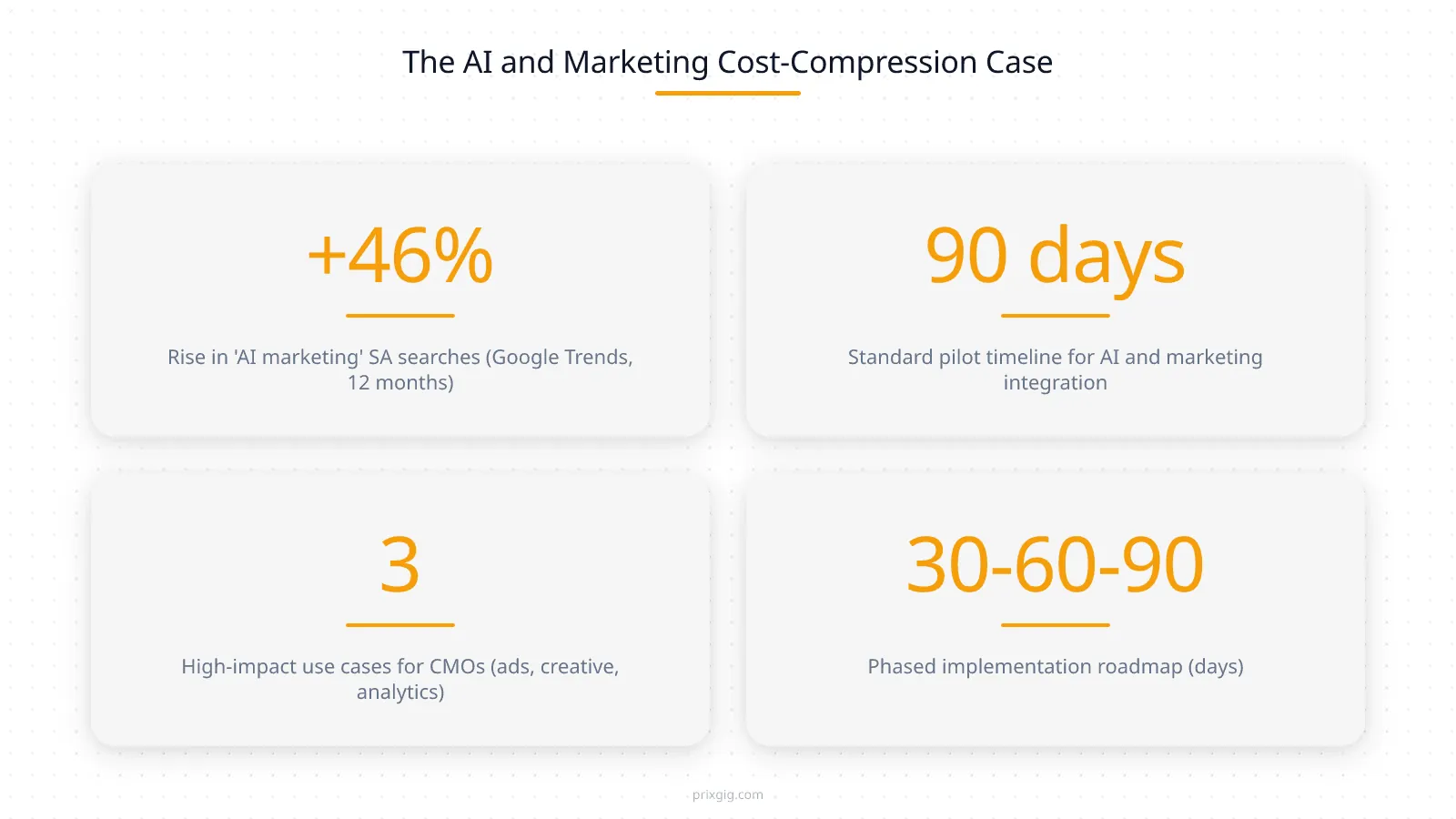
Three high-impact AI and marketing use cases for CMOs
Not every application of artificial intelligence in marketing matters equally. CMOs have limited bandwidth and limited credibility budgets inside their organisations. Spending either on experimental pilots that do not connect to business outcomes is how these initiatives die in committee.
Three use cases consistently produce measurable impact when AI-driven marketing strategies are implemented. They are listed here in priority order — each one builds on the foundation the previous one creates.
Use case 1: Running ads optimisation with AI
This is the most immediate, highest-confidence AI and marketing use case because the platforms themselves have already built the infrastructure for it.
Google Ads Smart Bidding uses machine-learning models to set bids in real time across every auction, using signals that include device, location, time of day, remarketing list membership, browser, operating system, and hundreds of contextual factors that no human team can process at auction speed. Meta’s Advantage+ suite does the same for Facebook and Instagram campaigns. These are not optional features that early adopters toggle on — they are the default for any performance operation running at scale.
The CMO’s role here is not to understand the algorithms. It is to ensure three things are in place: first, that the conversion data flowing back to the platforms is accurate and complete (server-side tracking, not just browser pixels); second, that the primary KPI the bidding system is optimising toward matches the business objective (cost-per-qualified-lead, not cost-per-click); and third, that the team is measuring incrementality, not just attribution. We covered the data plumbing required for this in Why SA Businesses Waste 60% of Their Paid Ads Budget.
Use case 2: Personalised creative at scale
The second AI and marketing use case that produces measurable results is dynamic creative production. This is where generative AI tools — text, image, and video — allow a marketing team to produce variant creative at a volume and speed that was previously uneconomical.
The use case is not “AI writes all our ads.” The use case is: a senior creative director sets the strategic brief, defines the brand guardrails, and approves the conceptual direction. AI-powered production tools then generate dozens of variants — headline options, image crops, copy angles, format adaptations — that the team can test across audiences and platforms simultaneously. The human provides the judgment and the brand context. The AI provides the production volume.
This is relevant for CMOs because creative fatigue is one of the primary drivers of declining ad performance over time. An AI-driven creative workflow that can refresh variants weekly instead of monthly extends the effective life of each campaign and reduces the cost per usable asset.
Use case 3: Attribution, forecasting, and predictive analytics in marketing
The third high-impact use case addresses the measurement problem that plagues every CMO’s reporting stack: attribution is unreliable, forecasting is based on historical averages that do not account for changing conditions, and most marketing dashboards report on lagging indicators that tell you what happened, not what is about to happen.
Predictive analytics in marketing uses ML models to forecast outcomes — expected conversion rates, likely customer lifetime value at the cohort level, and predicted budget efficiency under different allocation scenarios. These are not crystal balls. They are statistical models that get better as they ingest more data, and they are most useful when combined with incrementality testing (covered in the measurement section below).
For CMOs, the practical application is this: instead of reporting “we spent R500,000 last quarter and generated 200 qualified leads,” an AI-powered analytics system can project “given current trends, next quarter at the same spend level will produce 180 to 220 leads, with the highest efficiency from channels X and Y.” That is a fundamentally different conversation to have with a CFO or board.
Data foundations required — the CTO handoff checklist
Every initiative at the intersection of AI and marketing eventually hits the same wall: the data is not ready. The models are available, the use cases are clear, the budget is approved — and then someone discovers that the CRM has no consistent lead-source tagging, the Meta Pixel is firing on the wrong events, the consent flows are not POPIA-compliant, and the offline conversion data has never been connected to the ad platforms.
This is not the CMO’s problem to solve technically. But it is the CMO’s problem to own politically. The following checklist is what the CMO needs to hand to the CTO with a deadline and a shared KPI. AI and marketing performance depends on every item on this list being completed before any serious pilot begins.
1. Customer Data Platform (CDP) or unified data layer. All customer touchpoints — website, CRM, ad platforms, email, WhatsApp, call centre — must flow into a single system of record. Without this, the models are working with fragmented data and producing fragmented results.
2. Identity resolution. Can you match an anonymous website visitor to a known lead in your CRM when they convert? Can you connect a Meta lead-form submission to a closed-won deal in your sales pipeline? Identity resolution is the bridge between ad spend and business revenue. Without it, attribution is guesswork.
3. Server-side tracking. Browser-based tracking (cookies, pixels) is increasingly unreliable due to ad blockers, browser privacy settings, and iOS restrictions. Server-side tracking — Meta’s Conversions API, Google’s enhanced conversions — sends conversion data directly from your server to the platform, bypassing the browser entirely. This is not optional for any serious AI-driven implementation. We detailed the technical setup in Why SA Businesses Waste 60% of Their Paid Ads Budget.
4. Consent management and POPIA compliance. Every tracking event, every cookie, every server-side API call that processes personal information must be covered by a POPIA-compliant consent flow. This is a legal requirement in South Africa, and it is a prerequisite for any system that relies on first-party data. CMOs who skip this step are building their capability on a compliance vulnerability.
5. Offline conversion import. The ad platforms can only optimise toward what they can measure. If a lead converts to a sale offline — via phone call, in-person meeting, or email — that conversion data needs to flow back to Meta and Google so the algorithms can learn which types of leads actually produce revenue. Optimisation without offline conversion data means the system is optimising for leads, not revenue.
6. Data quality and hygiene. Duplicate records, missing fields, inconsistent naming conventions, and stale data all degrade AI and marketing model performance. A data quality audit should happen before any pilot, not after the pilot produces confusing results.
This is the handoff. The CMO owns the business case and the priority. The CTO owns the delivery. AI and marketing performance is a joint outcome — and the CMO who treats data infrastructure as “a tech problem” will get exactly the results that bad data produces.
Measurement and incrementality — proving AI and marketing ROI
Attribution dashboards lie. Not intentionally — but structurally. Every ad platform has a commercial incentive to claim credit for conversions that would have happened anyway. Last-click attribution ignores the role of upper-funnel activity. Multi-touch attribution models assign credit based on assumptions baked into the model by the vendor that built it. CMOs who report ROI using only platform-reported attribution are likely overstating the true contribution of their paid campaigns.
The corrective is incrementality testing — measuring what happened because of the marketing activity versus what would have happened without it. There are three practical methods CMOs should understand for measuring incrementality:
Geo holdouts. Select matched geographic regions. Run the campaign in the test regions. Withhold it from the holdout regions. Compare the business outcomes (revenue, leads, conversions) between the two groups over the test period. The difference, after controlling for baseline variation, is the incremental contribution of the spend.
Randomised controlled tests (RCTs) on-platform. Both Meta and Google offer built-in conversion lift studies that randomly split audiences into exposed and control groups. These are the closest thing to a true experiment available in digital advertising and are a strong tool for validating performance claims.
Time-based holdouts. Pause the campaign in a specific channel for a defined window (typically two to four weeks). Measure the drop in business outcomes during the holdout period compared to the pre-pause baseline. This is less rigorous than geographic or randomised testing, but it is operationally simpler and can reveal whether a channel is genuinely incremental or merely capturing demand that would have converted through another path.
Illustrative scenario (not based on a specific client):
|||quote|||A CMO running paid campaigns across Meta and Google Search suspects that the Google Brand Search campaign is capturing conversions that would have happened organically. A two-week brand-search holdout test shows that 70% of the “conversions” attributed to the brand campaign still occur during the holdout period through organic search. The team reallocates the brand-search budget to prospecting campaigns, where incrementality testing shows genuine lift. Total lead volume stays flat while cost-per-incremental-lead drops by approximately 25%.|||end_quote|||
This scenario is illustrative — it is not based on a specific client engagement and the figures are not sourced. But it reflects a pattern that is well-documented in the digital marketing measurement literature: brand search campaigns frequently over-report incrementality, and reallocation based on holdout testing can materially improve true marketing efficiency.
CMOs who build incrementality testing into their AI and marketing measurement stack — rather than relying solely on platform-reported ROAS — will make better allocation decisions and will have a stronger case when presenting AI and marketing ROI to the board.
Vendor selection and commercial alignment
When a CMO decides to bring in an external partner for AI-driven marketing execution, the vendor selection process determines whether the engagement produces compounding returns or becomes another line item on the marketing P&L that nobody can justify at renewal.
We covered the detailed vetting framework in How to Choose the Right AI Agency for Performance-Driven Growth — a five-category evaluation covering pricing, technology stack, proof methodology, reporting access, and pilot structure. That framework applies directly to any vendor evaluation in this space.
For CMOs specifically, three additional considerations matter in AI and marketing partner selection:
1. Commercial model alignment. The vendor’s commercial model should align with the CMO’s business outcomes. Fixed retainers paid regardless of results create misaligned incentives. Performance-based models — where the vendor’s fee is tied to measurable business outcomes — align both parties toward the same goal. PRIXGIG’s model is structured this way: performance first, then commercial engagement. No retainer during the proof phase.
2. Data access and ownership. The CMO must retain full ownership of all data generated during the engagement — ad accounts, creative assets, audience data, conversion data, and model outputs. Any vendor that requires you to use their ad accounts or refuses to export raw data is building a dependency, not a partnership.
3. Incrementality commitment. Any credible vendor should be willing to run incrementality tests (geo holdouts, on-platform lift studies) to prove that their work is producing genuinely new business outcomes, not just capturing demand that would have arrived anyway. Vendors who refuse to test incrementality are typically the ones who know their numbers will not survive the scrutiny.
For the broader evaluation, including the specific contract clauses and red flags to watch for, refer to our earlier post on How to Choose an AI Marketing Agency That Delivers ROI Before You Pay.
Organisational design and talent for AI and marketing teams
The capability a CMO builds at the intersection of AI and marketing is only as effective as the organisation designed to support it. This is where most initiatives stall — not because the technology fails, but because the org chart was never updated to accommodate it.
The centre of excellence model
The most effective structure for scaling AI and marketing across a marketing organisation is a centre of excellence (CoE) — a small, dedicated team that owns the tooling, develops the playbooks, trains the broader marketing team, and governs data quality and compliance.
The CoE does not replace the marketing team. It augments it. Campaign managers still run campaigns. Brand teams still own brand. The CoE provides the infrastructure, the training, and the quality controls that allow every function within marketing to use AI-driven tools effectively.
Key roles for an AI and marketing CoE
- AI and marketing operations lead. This person owns the tooling stack, the data pipelines, the model governance, and the relationship with external vendors. They are the bridge between the marketing team and the technical infrastructure.
- Data analyst / marketing scientist. This role owns incrementality testing, forecasting model validation, and the measurement framework. They ensure that performance claims are backed by rigorous methodology, not platform-reported vanity metrics.
- Prompt engineer / creative technologist. As generative AI becomes central to creative production, someone needs to own the prompt libraries, the brand guardrails for AI-generated content, and the quality control process that ensures AI-generated creative output meets brand standards.
- Compliance and governance lead. This person owns the POPIA, GDPR, and platform policy compliance for all data-driven marketing activities. In SA, this is non-negotiable — POPIA governs every data processing activity, and these systems process a great deal of personal data.
Skills gaps to address
CMOs will find that their existing marketing teams lack three skills that this shift requires:
- Data literacy. Most marketing professionals can read a dashboard. Few can interrogate the data behind it, identify quality issues, or design a test to validate a hypothesis. Data-driven marketing operations require a baseline level of data literacy across the team, not just in the analytics function.
- Prompt engineering and AI tool fluency. Using AI-powered marketing tools effectively is a skill that requires training and practice. A marketing manager who has never used a generative AI tool will not become proficient from a one-hour webinar. Budget for structured training and supervised practice time.
- Test design and statistical reasoning. Incrementality testing, A/B test interpretation, and confidence interval analysis are not intuitive skills. These teams need at least one person who can design valid tests and interpret results without the common pitfalls (peeking, underpowered tests, post-hoc rationalisation).
For a detailed look at how human teams and AI agents collaborate in practice — including the specific 11 functional specialisations and the operational rhythm — see What an AI Agency Does Differently.
Privacy, governance, and POPIA in the SA context
AI-driven marketing systems are, by definition, data-intensive. They ingest personal information at scale — browsing behaviour, purchase history, location data, device information, engagement patterns — and use it to make predictions, personalise experiences, and optimise campaigns. This creates a direct intersection between AI and marketing operations and data privacy regulation.
For CMOs operating in South Africa, the governing framework is the Protection of Personal Information Act (POPIA). POPIA applies to any processing of personal information by or for a South African entity, which includes every data-driven marketing activity that collects, stores, analyses, or acts on customer data.
What POPIA requires for AI and marketing operations
- Lawful basis for processing. Every data processing activity in an AI and marketing workflow must have a lawful basis — typically consent or legitimate interest. Consent must be specific, informed, and freely given. Pre-ticked checkboxes, buried consent language, and “by continuing to browse you agree” statements do not meet the POPIA standard.
- Purpose limitation. Personal data collected for one purpose (e.g., processing an order) cannot be repurposed for model training or audience segmentation without additional consent or a valid legitimate interest justification. CMOs need to audit their data flows to ensure that every data use is covered by the original consent or a documented legitimate interest.
- Data minimisation. These systems are designed to ingest as much data as possible. POPIA requires the opposite — collect only what is necessary for the stated purpose. CMOs need to work with their data teams to define clear data retention policies and ensure that ML models are not trained on data that should have been deleted.
- Cross-border transfers. Many marketing technology platforms process data outside South Africa — Meta’s servers are in the US, Google’s infrastructure spans multiple jurisdictions. POPIA restricts cross-border data transfers unless the receiving jurisdiction has adequate protection or the data subject has consented. CMOs must understand where their data is processed and ensure compliance with the cross-border transfer provisions.
GDPR and CCPA — global context for AI and marketing
For CMOs with global responsibilities or international customers, two additional frameworks are relevant:
GDPR (EU/EEA) sets the global standard for data protection and has specific provisions on automated decision-making that directly affect automated marketing systems — including the right of data subjects to not be subject to decisions based solely on automated processing.
CCPA / CPRA (California) gives consumers the right to opt out of the sale or sharing of personal information, which affects retargeting and audience-sharing practices for any business with California customers.
The practical implication for CMOs: compliance is not a one-jurisdiction exercise. If your operations touch customers in the EU, the UK, California, or South Africa, you need a compliance framework that satisfies the strictest applicable standard — and that is typically GDPR, with POPIA adding SA-specific requirements.
Governance framework for AI and marketing
Beyond legal compliance, CMOs should establish an internal governance framework for AI and marketing that includes:
- A use-case registry — a documented list of every AI and marketing application, the data it uses, the purpose, and the compliance basis
- Model monitoring and bias audits — regular checks on model outputs for bias, drift, or unexpected behaviour
- Human oversight requirements — clear rules on which automated decisions require human approval before execution
- Incident response procedures — what happens when a system produces an output that violates brand guidelines, compliance rules, or customer expectations
The 90-day AI and marketing implementation roadmap
. And for teams where the marketing execution will involve smaller business units, our [practical guide to AI for small business marketing](/blog/ai-for-small-business-marketing) covers the hands-on tools and adoption path.](/images/ai-and-marketing-insights-for-cmos/section-8-comparison-split.webp)
What to do this quarter
- Run the data readiness audit. Use the CTO handoff checklist in Section 3. If your tracking infrastructure, consent flows, and offline conversion import are not in place, nothing else matters. AI-driven marketing runs on data — and bad data produces bad results.
- Pick one use case. Not three. One. Running ads optimisation is the highest-confidence AI and marketing starting point because the platform infrastructure already exists. Start there.
- Define one primary KPI. The single metric that the pilot will be measured against. Cost-per-qualified-lead is almost always the right answer for SA service businesses. Not impressions, not clicks, not cost-per-lead — cost per lead that your sales team actually wants to talk to.
- Select a partner who will test incrementality. Any vendor worth hiring will agree to run an incrementality test. If they will not, they are not confident in their own contribution. PRIXGIG runs incrementality tests as standard — it is how we validate that our work produces genuinely new business outcomes, not just captured demand. See how we work.
- Set a 90-day deadline. Not a 12-month “digital transformation programme.” A 90-day pilot with a single use case, a single KPI, and a go/no-go decision at the end. That is how you build AI and marketing capability without overcommitting budget or political capital.
|||cta|||The cost-compression effect does not wait. Every quarter without a deliberate strategy is a quarter where your competitors’ unit economics improve and yours do not. The AI and marketing gap is real, it compounds, and the CMOs who act on it now will set the cost baseline that latecomers will struggle to match.
If you want to talk about what a 90-day pilot would look like for your specific situation, get in touch with PRIXGIG.|||end_cta|||
References
- Google Ads Help. “About Smart Bidding.” Link
- Davenport, Thomas, et al. “How Artificial Intelligence Will Change the Future of Marketing.” Deloitte Insights. Link
- McKinsey & Company. “How marketing leaders can use AI to transform performance.” Link
- Google Ads Help. “About Smart Bidding strategies.” Link
- Government of South Africa. “Protection of Personal Information Act, 2013 (POPIA).” Link
- IAPP. “What is the GDPR? — GDPR, a plain-English guide.” Link
External sources linked in this post — Deloitte Insights, McKinsey & Company, Google Ads documentation, IAPP, and the POPI Act — are provided for context and verification only. PRIXGIG does not independently verify the ongoing accuracy of third-party information.
The cost-compression analysis, organisational recommendations, and implementation roadmap in this post are based on common industry practice and PRIXGIG’s own experience working with SA businesses. They do not constitute a guarantee or forecast for any specific engagement. Results vary based on category, data quality, budget, organisational readiness, and execution. See the PRIXGIG earnings disclaimer for full context on how past-results claims should be interpreted.
Written by Claus x Johnny — PRIXGIG’s AI writing agent in collaboration with Johnny Nel.